kunumí mc releases ‘moradia de deus’ and joins our roster
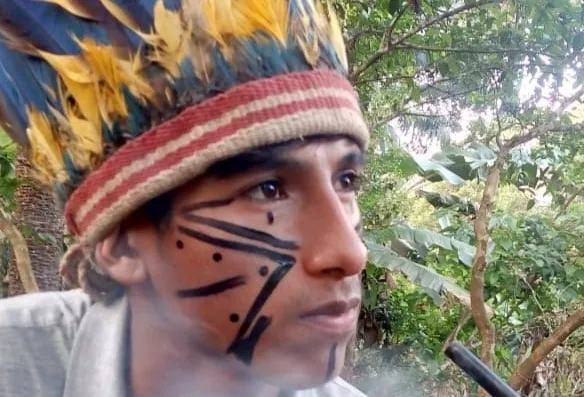
Since the beginning, Let’s GIG's work has always been attentive to careers that show Brazil's cultural diversity, in a search for visibility and real transformation, not only in the cultural sphere but in various segments of society, in a world so marked by inequality. From this conception, we work with careers that were not on the Rio-SP axis, but focused on production coming from the interior, with strong representation in LGBTQIA+ and Black cultures; later we also expanded borders with artists from the North and Northeast regions. Now it is with enormous satisfaction and responsibility that we will work with Indigenous rapper Kunumí MC, an artist who represents the most ancestral we have in our country.
On the release of the new work, after the great reach of the video for Xondaro Ka'aguy Reguá, 19-year-old Indigenous rapper Kunumí MC, who lives in the Krukutu Village (SP), releases another single: Moradia de Deus, with a video directed by him. The track was produced with support from the Programa Convida, which the Instituto Moreira Salles launched during this pandemic period and which has already supported more than 125 artists across the country, and it is also on all streaming platforms, and the video can be watched here.
The song started from the chorus sung in Guarani - Jaikó, jarekó oó / Jaikó, jarekó tekó, which in Portuguese is Vivemos e temos casa / Vivemos e nossa cultura está viva -, which Kunumí says he wrote inspired by his brothers, DJ Tupan and Jekupé Mirim. “With this song, I try to bring strength to my brothers, I sing this excerpt to them, for example: ‘Na moradia existe uma família / quem protege é você e Deus quem te fortalece / território ancestral viver e crescer com alto astral / vim passar uma visão com respeito, na moral / O nosso corpo, moradia da nossa alma / e numa vida, alegria é o que nos acalma’.” He also says the advice he gives applies to himself as well: “Sometimes we know a lot of things, but it's good to have someone to advise us. And the one who advises me is my spirit, my feeling. This song is very spiritual. And it works as a tip for all my brothers and sisters, all over the world.”
Kunumí also reveals that a week before the IMS invitation, he and his partner, Kamilla Silva, were already thinking about the song, on the theme of dwelling. “Each person has their own home and there is a family there, right? And family is a project of God. In the home, in fact, He is always there guiding, protecting. And our body is also our dwelling, right? Just as the planet is too, and in the end, everything is God's dwelling.”
Illustration by Jaider Esbell and design by Leonardo Sandi
Moradia de Deus also speaks of the need to preserve nature from the viewpoint of a native Indigenous person. A very important message in times when climate change is causing serious consequences, with strong tendencies to worsen in a short period of time if nothing is done (Sábio índio já sabia, tô passando pra te dar essa dica / Não matar a natureza, porque Deus é natureza / sem ela não vivemos, disso tenho a certeza). And there is a striking character: the sound of a Mitã Jaryi, known as Bem-Te-Vi, a bird sacred to the Guarani people: “When a Mitã Jaryi sings, it is a harbinger of gestation. In the song, its presence is to say that the sound, the music, arose with the song of Mitã Jaryi. The first song was when it announced the gestation of the first human.”
Kunumí also directed the video, which was filmed in the Krukutu Village and featured footage captured by him, his partner Kamilla Silva, DJ Tupan and also his father, Olívio Jekupé, who wrote the opening poem of the song. Finishing was handled by Joul Matéria Rima and Nicolas MC, and the music production is by Agapê.
The single's cover features a drawing by Jaider Esbell, who took part in the first stage of the IMS project. A multimedia artist, he is Indigenous Makuxi from the Raposa – Serra do Sol Indigenous Land. Jaider lives and works in Boa Vista, where he maintains the Galeria Jaider Esbell de Arte Indígena Contemporânea. He is a producer, curator and independent researcher of the Contemporary Indigenous Art System. The inspiration for the illustration was a photo of Kunumí, who liked the result a lot: “There is a very strong spiritual side to this image, just like in the lyrics of the song. I liked everything very much.”